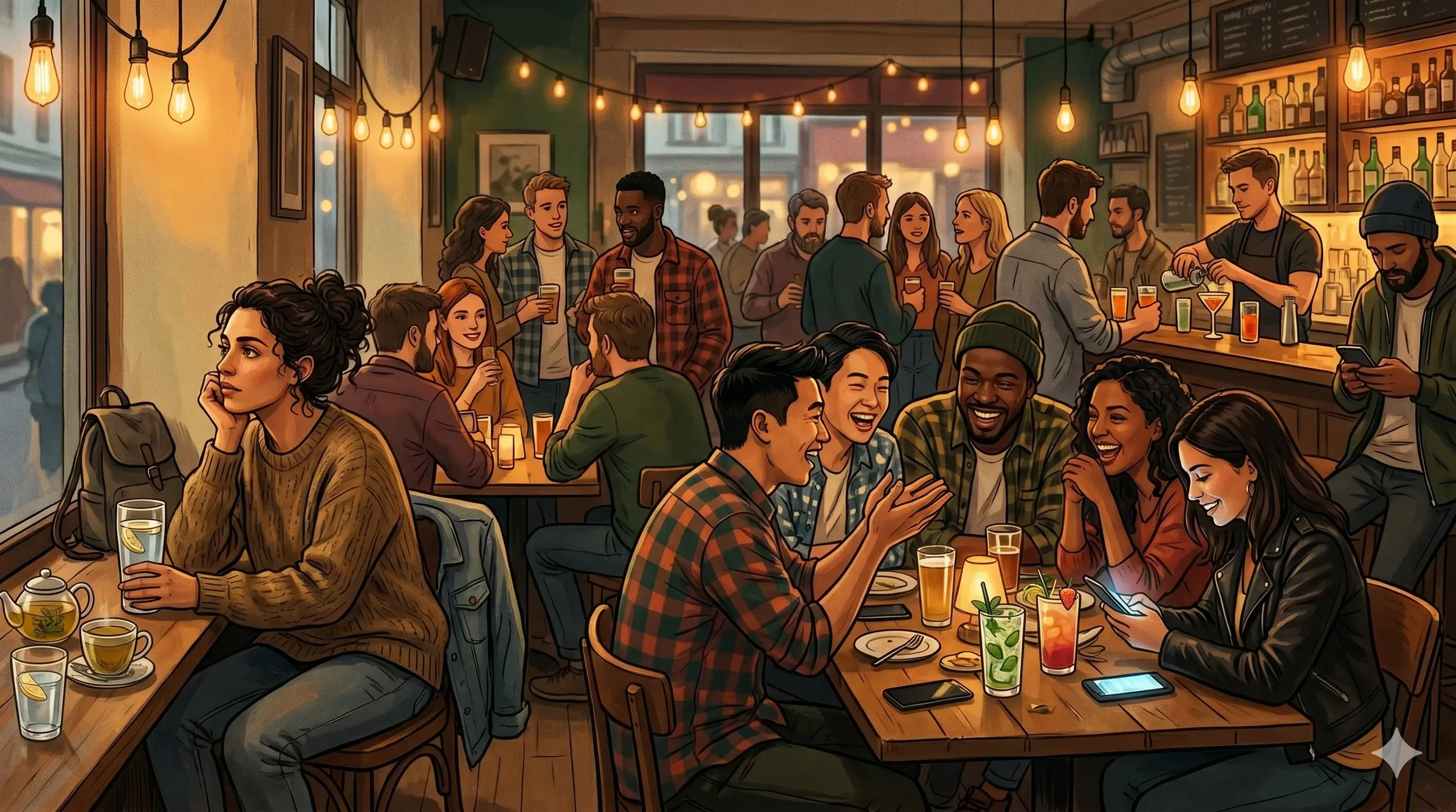
You land in a new city, open the expat or nomad group, and within 24 hours you’re at some kind of social thing.
Drinks by the beach, trivia night, coworking meetup, sunset picnic, salsa, “entrepreneur networking,” breathwork, you name it.
You spend three hours with people.
You talk about where you’re from, how long you’re staying, what you do, maybe even something slightly personal.
You add each other on Instagram.
You go home thinking, “Okay, maybe I’m finally meeting people.”
And then the next day, one of them walks past you at another event, looks straight through you, and says:
“Sorry, what was your name again?”
After the fifth “what was your name?” in the same week, you start wondering whether half the city has early‑onset dementia or whether you are, somehow, forgettable.
The Social Life That Runs on Substances
One of the things you quietly notice, without wanting to sound judgy, is how much of the “community” runs on alcohol and other stimulants.
Pre‑drinks to get the courage to go to the event.
Shots at the bar because “we’re celebrating life.”
Something to bring you up, something to bring you down, something to make the social part easier.
Psychologists call it self‑medicating: using alcohol or drugs to suppress anxiety, stress, or low mood, especially around social situations.
In a lot of expat and travel circles, it is so normalised that it doesn’t even register as coping anymore; it’s just “how we do things here.”
You may find yourself asking uncomfortable questions:
Would half of these events exist if there were no alcohol?
Would some of these conversations still happen if people were sober after 10 pm?
The Self‑Diagnosis Shield
Another pattern you might recognise: the casual list of labels people throw around about themselves.
“I have ADHD.”
“I’m autistic.”
“My anxiety is really bad.”
Sometimes these are real diagnoses and real struggles, and they deserve care and understanding.
But often in these circles, they also become a shield: a ready‑made explanation for flakiness, emotional unavailability, or unkind behaviour.
“I didn’t message back for three weeks, my ADHD is so bad.”
“I walked away while you were talking, my social anxiety kicked in.”
The strange thing is: the same people who explain away their behaviour like this are often furious when someone else treats them with the same inconsistency or lack of basic respect.
It’s not that ADHD, autism, or anxiety are not real.
It’s that neurodivergence and mental health challenges become aestheticised and weaponised online, and then dragged into real life without much reflection.
Labels become a way to avoid responsibility, instead of a way to understand yourself better.
Meanwhile, you are left holding the emotional confusion of being treated as disposable, while being asked to be endlessly understanding.
The 15‑Second Attention Span Friend
The social rhythm in many expat places feels like this:
Meet someone.
Share life stories in 15 minutes.
Feel strangely close for one evening.
Become strangers again by tomorrow.
You see the same faces in ten different activities in the same week.
They sit next to you in a language exchange, then again in a coffee meetup, then again at karaoke.
Each time, the conversation resets back to “So, where are you from?” like the previous evening was wiped from history.
It’s not that people are evil.
A lot of them are just overwhelmed, over‑stimulated, constantly meeting new people, constantly on the go.
Attention has become fragmented into tiny, 15‑second units.
And when attention becomes that fragmented, people do too.
What this does to you emotionally:
You start doubting the reality of the connections you think you built.
You question whether you misread the warmth of yesterday.
You feel like a ghost that occasionally becomes visible and then disappears again.
“Sorry, What Was Your Name Again?” (Again, and Again)
There is a specific kind of loneliness that comes from being constantly re‑introduced to people who have already heard your story.
Being forgotten once is human.
Being forgotten every week by the same person who has shared a drink, a dance, or a “deep” conversation with you starts to feel like erasure.
Over time, this can do something subtle but heavy to your nervous system:
You begin to expect that you won’t be remembered.
You stop sharing as much because “what’s the point, they’ll forget.”
You may even start putting yourself in the background on purpose, to protect yourself from the disappointment.
This is emotional loneliness in a very specific form: surrounded by people, recognised by almost no one.
Dating the Local, Forgetting the Self
There is also the dating dynamic that many people quietly observe but rarely say out loud.
In almost every country, you find some version of the same conversation:
“The local girls/women here are so feminine, so submissive, so easy‑going.”
“Women back home are too difficult / too masculine / too demanding.”
The country changes.
The adjectives stay strangely similar.
Often, the women being praised this way:
Don’t share the man’s language fluently.
Don’t know his culture deeply.
Don’t really have the space to be fully themselves in the relationship.
The relationship becomes a fantasy loop more than a partnership.
A person from one culture projecting what they want to see onto someone from another culture, often supported by economic and social power imbalances.
The irony is: this tends to leave both people lonely.
The man is never fully seen for who he is, just for what he provides.
The woman is never fully seen either, just for how she fits into someone else’s narrative of “feminine, submissive, local.”
Not Everyone Is Like This (And That’s Important to Say)
None of this is meant to say: “All expats and digital nomads are shallow, self‑absorbed, or using others.”
That would be unfair and untrue.
There are people building deep, loyal, long‑term friendships abroad.
There are people quietly doing the emotional labour of remembering names, checking in, being there when someone is sick, helping people move, sharing real life, not just highlights.
There are sober spaces, gentle spaces, neurodivergent people doing their best to be kind and accountable, hosts who genuinely care about the humans in the room, not just the numbers on the RSVP list.
The point is not that everyone is like this.
The point is that the people who treat others as disposable, who numb themselves, who stay in the fantasy level of connection - those people are everywhere, and they are often perceived as “normal.”
If you’re wired for depth, it’s easy to feel like you’re the weird one for noticing any of this.
When You’re Wired for Depth in a Shallow Circuit
If you’re someone who:
Remembers names and details.
Notices when someone is not okay.
Feels uncomfortable with “let’s get wasted” as the main form of bonding.
Actually wants to talk about something real, at least sometimes…
…then these environments can make you feel like an alien.
You might start thinking:
“Maybe I’m too sensitive.”
“Maybe I expect too much.”
“Maybe wanting someone to remember my name is asking for too much.”
It isn’t.
Wanting to feel known, remembered, and treated as a human being is not a character flaw.
It’s a very basic human need.
The problem is not that you’re “too deep.”
The problem is that a lot of modern social life - especially in transient expat and nomad hubs - is built on speed, novelty, and escape, not on continuity and care.
Small Ways to Protect Your Inner Life
You don’t have to become cynical or isolate yourself to survive this.
You also don’t have to pretend you don’t see what you see.
A few gentle experiments you might try:
Choose depth over quantity: fewer activities, but return to the same spaces and people so there’s a chance for continuity.
Notice your own numbing habits: what you reach for before events, after events, late at night in a new city. Ask, “What feeling am I avoiding right now?” instead of judging yourself.
Set your own minimum standard: you remember names; you follow up; you ask one real question beyond “Where are you from?” and “How long are you staying?”
Allow yourself to walk away from spaces where your values are trampled or mocked. You’re not “too sensitive” for leaving a table that hurts you.
Most importantly: let yourself admit that this hurts.
You don’t need a dramatic story to justify why you feel lonely.
Being repeatedly treated as replaceable is enough.
If You Want One Space Where You Don’t Have to Perform
This is exactly why I created Unburdora.
Unburdora is not therapy, and it’s not crisis support.
It’s a quiet, private corner of the internet where your inner life is allowed to exist without being turned into content, advice, or a performance.
In our one‑to‑one sessions, you can:
Talk honestly about what it’s like to be the person who remembers everything in a world that treats people as interchangeable.
Process the emotional hangover of expat and nomad social life, without being told to “just go to more events” or “be more open.”
Explore how you actually want to connect, and what boundaries and choices would make your life abroad feel more like a life and less like a never‑ending audition.
If you recognize yourself in this article and you’re tired of feeling like a background character in other people’s adventures, you’re welcome to book a session with me through Unburdora or, if you’re unsure whether this is the right space for you, you can also start with a free 10-15 minute chemistry call (offered once per person) to simply talk it through first.
You don’t need a perfect story or a clear “problem” to justify it.
“Something about this life feels shallow and I’m tired of feeling alone in it” is enough.