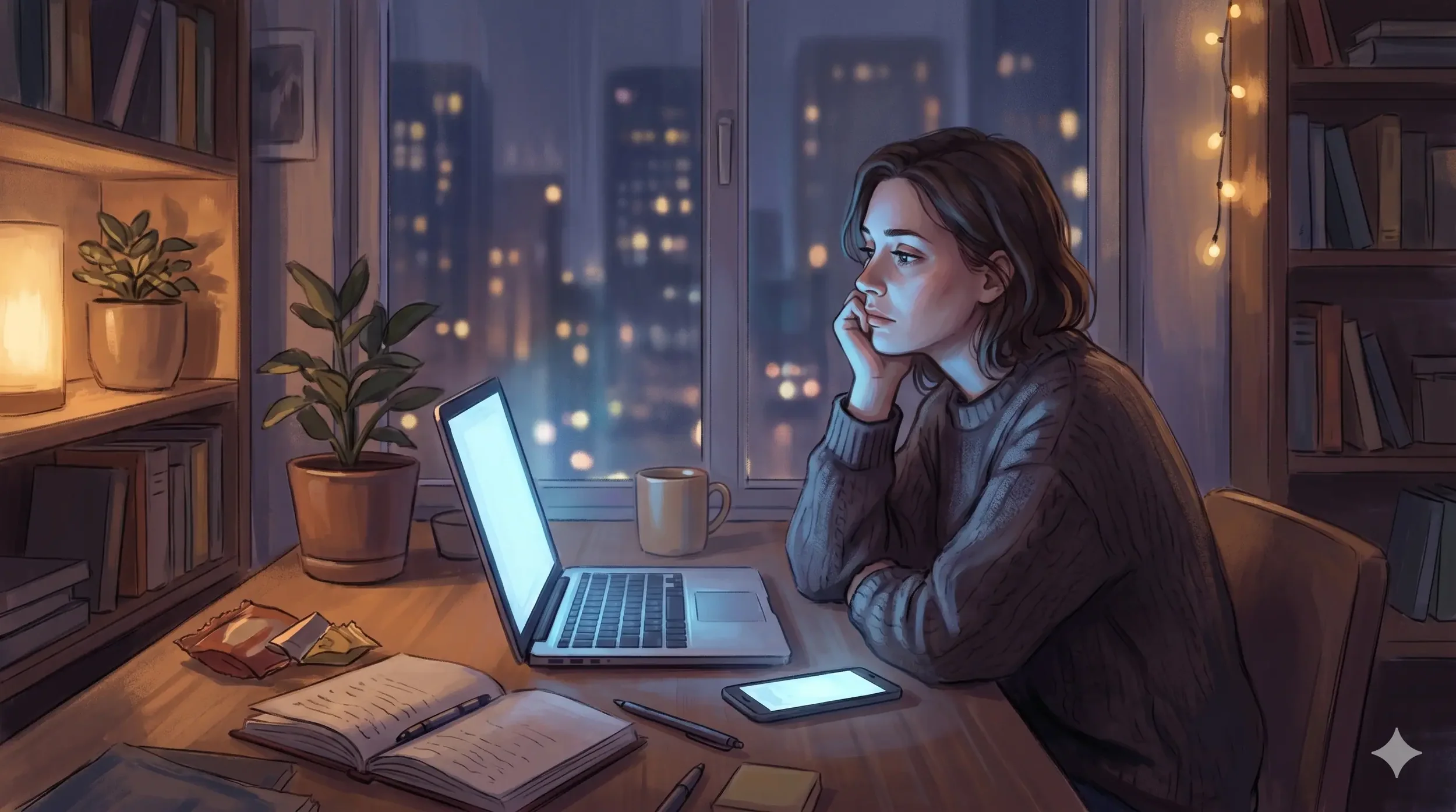
There is a quiet moment that many people never talk about.
You are in the middle of feeling something real, hurt after a conversation, pride after doing something difficult, a soft ache of loneliness at the end of the day, and before the feeling can even land, another part of your brain is already drafting a caption, a post, a story, a “lesson.”
The feeling has barely existed and it is already being packaged.
In a world where personal branding is treated as almost mandatory, more and more people are living like this, not only full‑time creators or influencers. Colleagues are encouraged to “share their authentic stories” on LinkedIn, founders are coached to be “the face of the brand,” and even private accounts can start to feel like small stages.
From the outside, it looks expressive, confident, connected. On the inside, many people are quietly exhausted and strangely alone.
Unburdora exists for exactly this kind of person: someone who seems perfectly articulate and high‑functioning, but who is tired of living at a distance from their own inner life.
When the self becomes a product
Over the last decade, a huge part of the economy has been built on visibility and personal storytelling. People are encouraged not just to do good work but to constantly document it, narrate it and turn it into a stream of content.
Professionals are told that a strong personal brand is essential for career security.
Creators and entrepreneurs are rewarded when they share more of their vulnerabilities, traumas, and “behind‑the‑scenes” struggles.
Platforms amplify posts that are emotionally charged and highly engaging, especially when they invite self‑disclosure.
None of this is automatically bad. Storytelling can be powerful and healing. But something important happens when the very things that make you a person, your fears, your doubts, your relationships, your inner monologue, become raw material for algorithms and audiences.
A growing body of research on creators and knowledge workers shows high rates of burnout, anxiety and feelings of isolation, even among people who appear highly connected online. It is a strange experience to be visible and unseen at the same time.
At Unburdora, I hear versions of this often: “Everyone online knows so much about me, and yet there is almost no one I can actually call when it is 11 p.m. and I feel like I am falling apart.”
Three inner splits that slowly hollow you out
When your inner life is continually turned into content or brand‑story, certain psychological splits start to appear. They are subtle at first, but over time they can lead to a kind of emotional loneliness that is hard to name.
1. The performed me vs. the felt me
There is the version of you that is coherent, knowable, explainable in a neat paragraph, the LinkedIn bio, the “about me,” the polished introduction on a podcast. Then there is the version of you that is messy, contradictory, not fully processed.
When your livelihood, reputation, or opportunities depend on how the performed version is received, it becomes very tempting to manage yourself like a product. You start curating not just what you show, but what you allow yourself to feel.
Over time, people describe feeling strangely flat inside, even when a post performs well or a brand opportunity appears. The outer story continues. The inner story goes quiet.
Unburdora is designed as a place where the “felt me” is allowed to exist without being immediately turned into anything, not a post, not a piece of content, not a lesson. Just a human experience, in a room (online) where no one is taking notes for later.
2. Public vulnerability vs. private numbness
We live in a culture that rewards vulnerability when it is well‑packaged. Posts about burnout, anxiety, neurodivergence or trauma often receive high engagement, not because they are fake, but because many people genuinely resonate with them.
However, there is a difference between being vulnerable in a structured, controlled way and being vulnerable in real time with another person. Public vulnerability can become another performance, another way of managing how you are seen.
Some people find that the more they talk about their feelings publicly, the more numb they become privately. They can write or speak about pain, but they struggle to actually feel it in their own body, or to let someone close to them see it live, unedited.
A space like Unburdora is the opposite of this dynamic: you are not performing insight or relatability. You are allowed to be in the middle of something without having figured out the “takeaway” yet.
3. Audience connection vs. actual support
You can have thousands of followers, colleagues who enjoy your content and clients who appreciate your work, and still have no one you can lean on without worrying how you appear.
Many people describe a kind of parasocial role‑reversal in their own lives: they are the one others confide in, they are the steady, reliable, “sorted” friend or colleague. They are deeply emotionally available to others, while quietly starving for the same thing themselves.
This creates a lopsided emotional ecosystem. You are always holding space, but almost no space is held for you. The more competent you appear, the less people imagine you might need that.
Unburdora exists precisely as a counterweight to that: a private, non‑clinical, one‑to‑one space where you are the one who is allowed to be carried for a while. No one needs anything from you here.
How this turns into emotional loneliness
Emotional loneliness is not the same as simply being alone. It is the experience of having very few places where you can bring your full, unedited self, including the parts that are contradictory, unfinished, or not especially “on brand.”
When you are constantly in performance mode, even subtly, several things tend to happen:
You hesitate before sharing something, checking if it makes sense with how people already see you.
You downplay feelings that don’t fit the narrative you have created for yourself.
You find yourself exhausted after social interactions, not because you dislike people, but because you were curating yourself the whole time.
Over months and years, this can lead to burnout, emotional numbness and a sense of being unknown, even in the middle of a busy life. Public health bodies and workplace reports are increasingly naming burnout and loneliness as serious, widespread issues, not personal failings.
From the outside, you might look like someone who is thriving, engaged online, articulate, responsive, productive. Inside, there is a quiet sentence that never quite leaves:
“Nobody actually knows how much I am carrying.”
Unburdora was created for exactly that sentence.
Protecting your inner life in a world that wants all of it
If any part of this feels uncomfortably familiar, you are not dramatic and you are not “too sensitive.” You are noticing that something precious, the privacy of your own inner life, has been slowly eroded.
Here are a few gentle, realistic ways to start protecting it again.
Have experiences that will never become content
Choose one small area of your life that is completely off‑limits for posting or storytelling. It might be a weekly walk, a relationship, a hobby, or a specific kind of journaling. Let it be unsearchable, unshareable, yours.Delay the impulse to narrate
When something intense happens, notice the urge to immediately turn it into a “story.” If you can, give yourself 24–72 hours before sharing anything about it. Let your nervous system process first; the narrative can wait.Differentiate between “helpful for the audience” and “healthy for me”
Just because a story might resonate publicly does not mean it is kind to your present self to share it right now. Ask, “Is this healed enough to be a story, or is it still a wound?”Notice where you feel emotionally over‑responsible
If you are the one everyone vents to, the emotionally literate friend, the person who always understands, pay attention to how little space is left for your own mess. Being good with other people’s emotions does not mean you should live without support for your own.Let at least one relationship be completely non‑transactional
This might be a friendship, a partner, a community space, or a setting like Unburdora, where you are not expected to perform, teach, inspire or entertain. You are allowed to show up simply as a tired, complicated human being.
Where Unburdora comes in
Unburdora is not therapy, and it is not performance coaching. It is a private, non‑clinical one‑to‑one space where you can think out loud, untangle what you are carrying, or simply have an unedited conversation with someone who is fully on your side.
It exists for people who look fine on the outside, often more than fine, but who quietly feel:
Emotionally tired from always being the strong, self‑aware one.
Numb or disconnected, even while they are doing “all the right things.”
Lonely in rooms (and feeds) full of people.
In our conversations, there is no algorithm to satisfy, no brand to maintain, no need to turn your experience into three neat takeaways. You do not have to be inspiring. You do not have to be grateful. You do not have to be “working on yourself” in a presentable way.
You are allowed to show up exactly as you are: half‑formed, contradictory, overthinking, emotionally overloaded or strangely empty. Together, we make room for the parts of you that never make it into your public story, not to monetise them, not to optimise them, but simply so you do not have to carry them alone.
If you recognise yourself here, you are welcome to treat this article as an invitation.
You can keep living a visible, ambitious, creatively engaged life. You do not have to choose between having a voice in the world and having a private inner space that belongs only to you.
If you are tired of always being “on,” Unburdora is here as a place where you can finally exhale.